
Is Fear the New “Normal”?

marynbel Normal.

What does that mean anymore?

normal (nôrˈməl)
adj. Conforming with, adhering to, or constituting a norm, standard, pattern, level, or type; typical: normal room temperature; one’s normal weight; normal diplomatic relations.
adj. Biology Functioning or occurring in a natural way; lacking observable abnormalities or deficiencies.
(http://www.wordnik.com/words/normal)

The status quo-AND/OR-“biology functioning in a natural way”.

Some days I don’t know what “normal” is either. For example, the “norm” for birth in this country (think induction, cesarean) may be average, but doesn’t exhibit “biology functioning in a natural way”. Maybe there isn’t a strict way of defining what IS normal, but there is a lot of attention these days as to what is NOT normal. And don’t get me wrong, I do it too. All of the time. We know so much, there has got to be a “reason” for everything and if that follows, there also has to be a solution, right??

Solutions come from problems. But how do we determine if there IS actually a problem?

We seem to have all these rules in our heads and have started to leave our hearts out of what is considered “normal”. Instead of looking at the big picture, we are all guilty of consulting our book of normal/abnormal for every little thing and then offering our fix, our answer. Even if it’s a “natural” solution, does everything require one? Does everything need to be explained?

Like I said, I do it too. I noticed not long ago that my newest babe is lip-tied. Hasn’t caused him any issues, but that’s not “normal” (or is it??). I was so tempted to “do something” about it; that MUST be why he doesn’t sleep at night, or why he was taking a while to eat solid foods! Suddenly, what’s normal for him became a problem. Something that needed fixing. (And for the record, after digging a little deeper within myself, I realized that these things are OK. This baby, this personality. But darn it, I want to sleep!:) Sometimes the “answers” are just being in it. Going through it.

There are so many examples of this lately, and my natural mothering world is no exception. I think it’s because we ARE smart and we ARE informed, and we take responsibility for our choices. But the needing to fix all of the time and “search and destroy” (as a friend so aptly put it) is diminishing our power as mothers, as women.

It is “normal” (in my circles, anyway) to question things. But where do we draw the line?

Not “enough” breastmilk? Then you need some milk producing herbs!
Feeling tired all of the time? Then your thyroid must be malfunctioning!
Labor too “long”? Then certainly baby was in a funky position!
Baby in utero having hiccups? Then there must be a food sensitivity!

Unless there’s not. A “reason” for any of these things, I mean. Unless all these things are normal, for this woman, this baby, at this particular place in time. Maybe she only thinks she doesn’t have enough milk because she’s pumping. Maybe the labor was “long” because that’s how the baby needed it to be. Maybe she’s tired because she’s nursing 2 kids and is up all night! Or maybe not. Our brains want to analyze, want to solve, want to do better. All this is OK…until somehow we are sort of back where we started. Full circle. We’re not trusting where we came from or where we are going.

So, I am offering that perhaps fear has become our new “normal”. Fear of missing something, of being wrong, of not covering all the bases. Fear of normal becoming…abnormal. Whatever happened to letting things be? Without needing to fix or solve everything. Forgetting that this is nothing more than imitation of the medical model that we tend to run from because of its tendency to band-aid everything and instill fear. How are we behaving any differently?

I want to stop trying to find solutions to things that are “biology occurring in a natural way”. Especially when there is nothing to fix, no one hurting and nothing wrong.

To admit that normal is normal or maybe that abnormal is normal, takes some guts.
When it’s in your own life, maybe less guts. After all, it’s your own life.

But when women come to us, other mamas, and want to know what we think-

It’s ok to say “I don’t know” or “that actually sounds normal to me”. We don’t have to make a problem where there isn’t one, because there is the trust we have in the natural processes (“normal” processes?) and ALSO the intuition of the woman. Not every woman is on to her own intuition. But it’s a growth process. It’s there, maybe hidden deep down under, for all of us. So, when asked about another, sometimes the best thing to offer is, “What do YOU feel?”

If a mama truly feels there may be a problem, she is probably right. But often when we are asked, that is not the case. We ALL need reassurance. Especially in pregnancy. We want to hear that baby hiccups are normal, not that some random internet source said they were tied to fetal hypoxia! We want to REASSURE normal. I want us to reassure normal, and not feel like we have to produce a problem and a solution for others at every turn. Or for ourselves.

I want to remember normal. And go from there.

Life is normal until proven otherwise. So is birth. And so are you.

What Makes Birth “Safe”?

_MG_2975What makes birth “safe”?

The answer to this depends on so many things…who is answering, what their beliefs may be and how they see the world.

It’s that controversial; and the answers to this question have created fear in some women, empowerment in others. It is the question that has led to the licensing of midwives, and the governmental control of Birth as an industry. It is also yet another divisive argument between caregivers of all kinds that work with women and birth.

To me, it’s a trick question. Because nothing makes birth safer than it already is. In it’s truest form, of course. The delicate dance of mom and baby, to complete a sequence that is normal and physiological. It’s already “safe”; at least, as safe as anything else that our bodies are programmed to do. Eating, sleeping, eliminating. We don’t question that these processes are “safe” for the average person. They just are. We don’t ask “what” makes them what they are.

But things are not this simple in the birth world. The medical world argues that certain PEOPLE make birth safe. And to make it even more complicated, they want to also specify WHO make birth “safe” and label them as for us.

It’s just all backwards. The normal, healthy pregnant woman does not need all this. She may not know that, because for as long as she can remember, she’s been told that birth is dangerous and that it cannot be accomplished without an “approved” handler present. Does that not sound SO ridiculous?? Do we get a recommendation for an “approved” neurologist to make sure that we are sleeping safely? Or from an approved gastroentorologist to make sure we are digesting normally? The average person does not.

The problem is the thought that birth NEEDS to be made any safer than it already is. But it’s actually not “safe” that many people are after; it’s birth being infallible.

How is this possible? How can we erase the possibility of death from birth? We cannot. They are two sides of the same coin, but this is an uncomfortable subject and not addressed by those that think other humans or special machines can save every baby and every mama. That is not real, and that is not life, unfortunately. There is an element of risk in everything we do in life; whether it’s crossing the street, or driving our car. Birth is no different.

But if I HAD to answer it, birth is safest when left to the natural order of things. We know this to be true in the animal world, and so it is with people, too. A healthy woman that feels safe, loved; no matter how much she “knows” about birth intellectually, will birth her baby her way, on her terms. It may be easy or difficult, it may be an awe inspiring experience or just another day for her! But the mechanism is there for birth to work.

And as far as the WHO is “safe”; well, I don’t think it’s any of our business to determine this for ANY woman. There is no way to quantify risk, TRULY, for another person. We cannot know what a woman is weighing as HER risks and benefits to choosing a breech vaginal birth, or a home birth with a preterm baby. There is no research in the world that can take into account the emotional and psychological and spiritual assessment that each woman will do to make the proper choices for herself and her baby.

We do not need third parties looking in and deciding this for us; I refuse to participate. I truly trust that birth is safe; and even if I didn’t, I truly trust each woman to make the choice that she needs to make. I can offer education, research, or just be her sounding board. But when she chooses an unassisted birth after several cesareans, for example, I am confident that SHE has done her own risk assessment and assessed herself in a way that no one else ever could. She may or may not want input, information, research from me to make her decision. What this woman (and any woman needs!) is support. I am here with you. I will stand by you. I can’t see the future or guarantee you a specific outcome. But I respect your choice and I trust in the inherent safety of the birth process. I do not control life or death. No one does.

But it’s not just the obstetricians that have decided when and with who birth is “safe”. Now midwives, the “guardians of normal birth” are arrogantly assuming the same thing. A doctor insisting that birth is safer at a hospital with a surgeon in charge is no different than midwives believing that only certain midwives make birth safe, and that just having a midwife makes birth safer than not having a midwife! Has anyone realized the irony of this stance? We say we believe that birth is normal, but then suddenly, it’s only “safe” if we are there to save it. Not every birth is uneventful or perfect, but many caregivers end up creating the problem or complication they were afraid of in the first place.

So, let’s end this on a positive note. Walking with women is the TRUE job of a midwife. And this walk is done differently from midwife to midwife. Ideally, all midwives would be educated, compassionate, up on current research, a wonderful counselor, etc. But even when not, we must trust that a woman will choose who she needs to accompany her on her journey. It does not matter what anyone else thinks, and birth is not less safe when this choice comes from her heart.

Birth is just as safe as it always has been, and will continue to be, if we allow women to lead.

An Open Letter to Women Who Care About Their Birthing Rights

December, 2012
To the Assistant to the Attorney General of Arizona
Director of the Arizona Dept. of Health
Arizona Office of Special License-Midwife Licensing

And to all the women that are concerned about their birthing options….

Two years ago, I served a wonderful, passionate, loving woman whose dream it was to birth at home after a cesarean years ago. She was amazing and strong and healthy, and so was her baby. She did not achieve her vaginal birth at home, but to no one’s detriment or fault. She and her baby were never threatened, and the outcome, although not what she desired, was favorable. To this day, I am not one bit regretful that I chose to stand by her. Her options in our rural area were to birth alone, or to agree to an elective cesarean at the local hospital. No woman should be forced into that choice. Her body, her baby, her choice to make. Birth at home with a midwife, even for a VBAC woman, is supported by evidence.

She had every right to be cared for and supported in her choice, and unlike many other midwives, I chose to not lie about it. I chose to not pretend I was unaware she had had a cesarean birth. What I chose was truth, and the truth really does set one free. Telling the truth and standing up for her and my beliefs was the best thing I have ever done. I do not regret one moment of it. After two years of being pursued by the State of Arizona for doing absolutely nothing except supporting a woman that no one would–I realize the real truth.

The real truth is that birth cannot be controlled. Women cannot be controlled, although you may try. Birth is not medical and it is not a medical event. It is not the duty of any state to determine how, where, why or with whom a woman births. It is not the business of the government to know women’s personal histories, their birth stories or anything else. Forcing a subpoena on me for client’s charts was not effective; you threatened me to get to them, and all to please a doctor. I have never, ever had a complaint filed against me by a client or her partner or her family. I have given compassionate, respectful, competent, research-based, motherbaby focused midwifery care. Let it be known that the ONLY complaints against me while licensed were from two doctors in the same rural hospital who are against and threatened by home births.

(In addition, a peer review of five experienced midwives in Arizona agreed. They deemed that my care on the three occasions that produced “complaints” from local doctors was every bit responsible, appropriate and even conservative. Shame on you, Arizona, for not having a peer component to your licensing “board”. Shame on you for ever making licensing involuntary. And as we all know, Arizona is only one of four states that licenses midwives and does not allow VBACs at home with midwives. This does not support current research.)

It is sad, but expected, that the “department” of licensing in Arizona chose to not investigate these complaints before threatening me with my license. They took the words of doctors, filed over the internet, above and beyond one of their licensees and any of my clients. It doesn’t add up, really, because there are Licensed Midwives I know of (illegally) attending VBACs, and to my knowledge, no other midwife has been harassed or disciplined (other than a Licensed Midwife being fined several years ago for attending a VBAC) by the “department” for what is “prohibited care” (this also includes twins and multiples). Midwives in this State have, do and will attend these women. I may never know the “whys” or “hows” I was pigeonholed, and I have made peace with that. I know enough to know that the dealings of the last two years have been unprofessional and revealing. They have confirmed my realization that birth is not the business of anyone that has not created the baby. And that licensing does not protect women, babies…or midwives.

Arizona has an archaic, conservative attitude that is hurting mothers and babies. This need for control, for perceived “safety” of moms and babies has been detrimental to a woman’s choice, and to true midwifery care. The Department of Health and the licensing office have no idea what it means to be a midwife. They have no idea what it is to have a baby, or to hire a midwife, or what makes normal birth “safe”. I am saddened that the word “midwife “in Arizona has come to mean “medical care provider”, and that the use of drugs and interventions is part of “normal” birth at home. The irony is, unbeknownst to you, these drugs and interventions create birth that is NOT safe at home. You have created the exact threat you think is being avoided. You’ve spent the last two years and lots of government money pursuing me, but you are barking up the wrong tree. My hope is that the women will eventually realize how severely their birthing rights have been limited; and because birth is a human rights issue more will begin to challenge the status quo.

I am a birth attendant. My loyalty is to women that choose me to serve them, and you can never take that away. Owning the term “Midwife” is ridiculous; however, please remove the title, “Licensed Midwife” from my name, and accept my request to take it back. I am purposefully not renewing my license, and will not be practicing midwifery in Arizona any longer. The women of Sedona no longer have the option of local home birth with an experienced birth attendant.

Thank you for helping me find my truth in birth. I started my career as a licensed midwife thinking that I made birth safer, or that I controlled it somehow. An arrogant attitude that many midwives hold. I now know I couldn’t have gotten it more wrong. I serve women, I guide them as they take back their births. Thank you for helping me find this truth; my truth in birth. I could not have done it without you.

“I found goodness in the place that I once believed to be evil; and found evil in the place that I once always knew to be good! The truth is so far separated from where I thought it existed. It can be such a wild, unbound journey: the journey from the illusion into the truth. Some people take that journey, but more people don’t.”
― C. JoyBell C.

With many blessings,

Maryn Leister
Former Arizona Licensed Midwife #159

Don’t Mess With Motherbaby

Motherbaby. The sacred duo that is not to be interrupted; but often we see or hear about tons of things coming between them. “Delayed” cord clamping at half an hour after birth, the hands of the midwife or student on that precious babe, wrapping the baby in blankets or putting a hat on the baby, the “newborn exam”, among many other things.

I question all of it. As a mother, I want you to question all of it. This interference is a bigger issue; not only does a midwife not have “right” to these things in a normal situation, but she is messing with way more than it looks like. What happens at the moment of birth, and in the minutes and hours and days after is sacred. It is sacred and priviledged and midwives should not mess or meddle with any of it. This is the beginning of the mothering, of the bond that will hold these 2 souls together for eternity. Yes, it is that crucial.

Women, mothers…you must question what these interruptions mean to you. It is a big deal that your midwife touches your baby at all in the postpartum period.

What if your midwife totally took your lead? If you wanted to weigh and measure your baby, she would help you (or your partner) do this. If you wanted a basic physical exam of your baby, she would be willing to allow you to feel and touch and explore your baby with her guidance. Either at birth, or the next day, when you felt more up to it. This is the birth “care” that I long for all mothers to have.

Because as mothers, this is what we want. When I see a photo of a midwife bathing the baby after birth, with the mother in the other room (yes, at a home birth) my heart breaks. My mother heart hurts. I am not sure if there is a disconnect between what happens at birth and after, for some women. But I know, as the birth servant, that it is my job to make that disconnect not an option. A baby is born to his mother and is part of her; carrying him across the room away from her or handling him naked away from her is that serious to me. I think these seemingly benign but very dangerous interventions that many midwives still practice need to be stopped. Immediately. And you, as the mothers, must insist upon it.

Your baby needs you and every cell of you at birth and after. Your smells, your warmth, your breast is crucial to the survival of your baby and to the bonding that will happen as a result. If you have ever given birth, you can feel that. It is in your programming to know this.

You may recall how other people in the room at birth was potentially a hindrance. The voices, the questions, the touching of you and touching of your baby. With each hindrance, taking you and the baby just a little bit away from your primal selves. Now add the barriers; the hat on the baby, the blankets someone throws over him even though he is warm on you, the touching and wiping and stimulating and talking. Suddenly your baby can’t smell you any more; he can’t feel you either but he can tell you are stressed. The adrenaline running through your body makes it that much harder to do what comes next and should come naturally. A physiologic release and birth of the placenta, easy breastfeeding fostered by a perfect blend of after-birth hormones. Doesn’t happen as well or as easily when we get between Motherbaby.

It’s too much. As midwives, we may have been taught these things and think the best of them still. How many midwives still think a newborn needs a hat to stay warm? Not realizing that this is a leftover from hospital births; that babies are warm on their mamas and that any degree of potential “cold stress” (while skin to skin) is normal and beneficial. The optimal hormone balance will support the baby’s system like nothing else. Allowing all of the baby’s warm blood from the placenta to reach equilibrium with the baby before cutting is another gift (this may not happen for at least 1.5 hours-3 hours after birth) and must be honored.

I’ve noticed that when left unbothered, mothers will not hat their own babes. They will not ask for blankets. They will not ask to cut the cord or do anything practical. They will do what they are programmed to do; which is touch and talk to the baby, smiling at him and making eye contact. This isn’t just “nice” behavior. This behavior is instinctual and beneficial. This behavior will also not happen if the mom feels watched or judged or feels fear from anyone in the room. It simply will not happen instinctively, and other issues may cascade as a result (postpartum hemorrhage is a great example).

So, as a mother, and one that cares very much about the generations to come, I implore you. Enjoy your gentle home birth, and then insist on being left alone. In a healthy birth situation, problems are created by these routine tasks most midwives are used to doing. I ask that you question them and know how much your baby depends on you to do that. Ask for quiet, intimacy and sanctity. Keep your baby on you, with you. Allow only the hands of your partner or other children to be the “others” that feels your baby’s sweet skin. Consider remaining clothes-less and skin-to-skin for days with your baby, and delay all requests for contact by others for as long as possible. This means the measuring and weighing and ointments and supplements that have become “routine”: if you must have them, administer them yourself.

As a midwife, I won’t be offended. Watching the birth of Motherbaby makes my mother heart happy. I offer you this sacred love, from mother to mother. Take joy and delight in this new soul and keep him, for now, all to yourself.

Breech!

This post is written in honor of the upcoming Heads Up Breech Birth Conference scheduled for November 9-11, 2012 in Washington, D.C. Anyone can attend, so feel free to pass this on to your midwife or doctor so that we can keep the skills of breech vaginal birth alive!

10 years ago, the Midwest. I was a brand-new midwifery apprentice, having seen maybe 2 other home births other than my own.

The call from the midwife came in, late afternoon…first-time mama was in early labor, her waters had opened and, surprise… there was fresh meconium. Breech.

I remember the moments of decision making between the midwife and the parents. Birth certainly wasn’t imminent, but there was an urgency to the situation to decide whether this would proceed as a breech birth at home…or a c-section upon arrival at the local hospital.

What followed was trust in birth. Breech as a variation of normal; a mom’s choice to stay home and birth her baby in whatever way he would come. In the then (and current) political climate (both in birth and the legalities of midwifery), a decision that would likely be judged as risky, or stupid or dangerous. A real-life lesson that a mama must birth where she feels safe and with whom she feels safe, making as an informed choice as is possible. And an attendant that would support her no matter what.

The clinical details are fuzzy because I didn’t know enough to know what I didn’t know. But perhaps more important, as an observer, I have a very clear emotional memory of this experience. One that would change me forever, and set me on the path of becoming a “birth trusting” midwife.

My own memories are of sleeping on and off on this woman’s carpeted bedroom; she labored quietly on her bed throughout the night, and a couple of us (there was another student and 2 midwives, total) took turns listening to the baby. I remember the waiting for her body to completely open and the reminders to not push until it was clear this had happened.

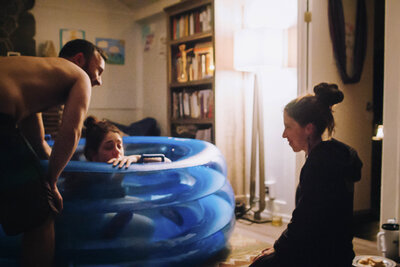
Early morning and the birth pool was being filled. I felt excited and giddy for the birth (as I had for all of them so far!) and did not feel fear from anyone in the room. At the time, I didn’t know how special this was; to allow this mama to birth her very first baby, in an unexpected way, without the energy of fear or disbelief that she could do it. Of course she could do it!

As we all looked on, her sweet husband supported her in the pool, and by the dim light of a flashlight I remember seeing more meconium…and then a tiny butt crown into the water. My most distinct memory of this birth was the butt, and then the little legs kicking in the water while the body remained inside. Quiet, peaceful. Only the whisper of the elder midwife to the other, “Now, don’t touch it!”

And there he was. All of him, birthed into the water. No panic, no emergency, no pulling. The perfect emergence of this special babe, birthed by his special mama, in a birth pool at home. No hands, only the water to support him. Breech.

To think that many people never see a natural, physiological birth; never mind a home birth. And to think that we all had the honor of witnessing this “physiological breech birth” at home is a gift. It wasn’t until recently, as a midwife myself, that I realized what a profound gift this was. And continues to be, as I serve women.

Because what this mama and baby did for me is plant the seeds of what birth is; breech or not. I respect birth, very much, but I am not scared of it. The decision to birth in a certain place or in a certain way or with a baby in a less-common position is the woman’s to make. As attendants, we are aware of our strengths and limitations but we do not let fear guide us. We let the woman guide us.

Because birth will happen. BREECH birth will happen, and we must be prepared in our hearts and minds to let it.

Being Told to Push in Labor? Think Again.

Caldeyro-Barcia’s (1979) studies showed what most midwives practice or believe intuitively; that coached pushing and prolonged breath holding by the woman during the pushing stage of labor is dangerous to the baby. He showed that this type of pushing caused placental perfusion issues (not enough blood flowing between baby and placenta) and resulted in fetal hypoxia. Aldrich, et. al (1995) showed that prolonged breath-holding decreased fetal cerebral oxygenation. Thompson’s 1993 study showed that women who had coached pushing for more than an hour, the babies had a lower pH at birth (meaning they were acidotic and likely stressed).

Basically, there is no evidence to support coached pushing but it still exists! Observational studies have shown the following complications that arise from coached pushing; maternal exhaustion, more assisted vaginal births, more episiotomies and tears, more impact on the pelvic floor and instances of urinary incontinence after birth.

Watching a woman’s body push her baby out is an education in these principles. I have observed that she will naturally breathe faster and slower as she needs to; she will grunt and hold her breath for short amounts of times, as she needs to. I would never pretend to understand exactly what is going on in her body to prompt her to do what she is doing. If she is unmedicated and allowed to follow her body’s lead, I think there is little that can go wrong. The most physiological way to push a baby out is with the body’s own cues. Some women will experience the “fetal ejection reflex” which can look like there is next to no “pushing”. It is a physiological expulsion of the baby by the body. When you’ve seen this happen, it is a world of difference between the forced/coached hospital (or home birth!) pushing that can turn women blue in the face.

So, despite what you have heard…there is no good reason (physiologically or otherwise) to think that anyone should tell you WHEN or HOW to push. You will know when it is time. You will do it just right, and with the greatest benefit to you and your baby and with the least amount of trauma.

4 Questions You MUST Ask Before Hiring Your Midwife

I’ve been attending births on my own for several years now. Every time I meet with a woman interested in midwifery or home birth, I realize how much I have grown and changed AND also how much I have to learn. I’ll never stop studying, researching, etc., but what these consultations make me realize is that learning about PEOPLE is a neverending journey as well.

From my own research, the “suggested” questions to bring to an interview with a midwife are amazingly terrible at getting to what you really want to know. The “standard” questions usually elicit the same answers from midwives that, in practice, are as different as night and day! So, what are some questions that might help you hone in better on what you’re gonna get?

What is your philosophy about birth?

This one can be informative and not. On one hand, it can cut to the chase of eliminating a midwife pretty fast. Like, if she says that birth is a precarious, scary event and you should have your car tanked up with gas because you’d probably need it to get to the hospital! (Seriously, I got this answer when I interviewed a midwife, a CNM, for our first homebirth 8 years ago. Needless to say, I ran as fast as I could from her; so, really, this could happen.) More typically, the midwife will answer that birth is normal and safe, yada, yada, yada. But how do you know that isn’t just the answer she knows you expect? And how do you know that her version of “normal and safe” is yours?

Hmmm. That brings us to the next question….

Describe your role when attending an average homebirth.

I like this one. I think if more women knew to ask this and knew what they were looking for, more women would not only find the “right” midwife, but that slowly the medicalized midwifery model (you know, a hospital birth at home) would die a pretty quick death.

First, what’s an “average” birth for the midwife in question? Hopefully, most of the births she attends are pretty average (read: uneventful) because she’s been a good guide on a healthy pregnancy road and she’s also a trusted presence at the labor and birth.

But back to the “role”; what’s the million dollar answer? That HER role is whatever you say it is. If that’s looking for support and guidance and monitoring of you and baby, then that’s what she does. If you are looking for someone to wash the dishes or watch the kids in the next room, then that’s what she does. As the birthing woman, YOU call the shots. It’s OK to not know what you’ll need, too. If it were me, I’d like the midwife in question to very clearly express that usually, her role is not a central one. She may even admit to birth not being any “safer” with her there; imagine that! Even better if she says that at most births, the family is in the leading role and she simply observes from afar without actually involving herself unless completely necessary.

How do you see most moms birth?

There is a misrepresentation of homebirth that is, like I said earlier, hospital birth at home. If that’s what you are looking for, I suppose you don’t need to read any further. If you are looking for undisturbed birth as your body intended, birth that happens at home, then read on. Physiological birth happens in whatever room, in whatever position that YOUR body decides on. I have been to too many med-wife attended births of woman flat on their back in their beds, with the midwife “delivering” the baby. This is not physiological birth. Who knows how your baby will want to come out? My last (unassisted) babe practically yelled at me to be in a deep squat, something I never, ever saw myself doing. If you don’t get the vibe that absolutely ANY position, room, pool, land, tee pee etc. is perfectly acceptable for you to birth in, then move on! The BEST bonus of following your body’s lead and not letting anyone influencing you is that you will likely birth more quickly, easier and with minimal to superficial/natural tearing. I think the average midwife’s tear rate/suture rate is absolutely insane. But, that’s what you get (often) for not birthing on your own terms!

And about suturing. Is it a true benefit to hire a midwife that can sew up a tear? I offer that it is NOT. Unless she has been a surgeon in another life, most midwives don’t suture tears nearly enough to be quick, accurate and proficient. And, if she IS that quick, accurate and proficient, you should really find out why. I have known at least a few midwives to suture for fun/practice. Tearing to a degree that requires sutures is a pretty serious thing and a situation, again, not usually encountered when birth is allowed to proceed physiologically. My feeling is that serious tears need to be sewn by a surgeon. Any minor tears probably should be left alone for natural healing. End of story.

And that one leads me into the standard equipment and drugs line of questions. THIS one is super fascinating and gonna really go against the grain. In fact, you may still expect that the answer to doing/carrying all this “stuff” is a MUST for any midwife that will be at your home for your birth. But guess what? It is an illusion of safety. Drugs (specifically for hemorrhage) and most of all oxygen DO NOT make a midwife safe. In fact, I’d argue after recent study (with the all amazing Jill McDanal) that if a midwife you are considering carries oxygen and thinks it is vital for a home birth that you RUN. Sound harsh?

I don’t think so. Remember that “hospital birth at home” statement? That’s really the bottom line when it comes to bringing drugs (and oxygen IS a drug!) into the home for birth. I don’t want to give away all the wonderful knowledge, time and committment that Jill has been putting into educating midwives about the dangers of using oxygen, so I won’t. But I will say that I would never consider oxygen for use in labor for mom (and baby) unless I also acknowledged that the birth would need to happen in the hospital. The same goes for hemorrhage drugs. Once you learn about the action these drugs have on the body, the inept way they attempt to treat complications, as well as the risk factors and side effects, you won’t want them anywhere near your homebirth. (On the other hand, if there IS truly an emergency that warrants medical treatment, you don’t belong at home anyway!)

Last question.

What tests am I required to do and/or what testing do you recommend?

So, this one is a trick question, in a way. If there are ANY tests that are “required”, according to the midwife and/or her license, you should really think about what that means for you. Some women don’t mind signing up for testing , necessary or not. I tend to think it is a fairly big deal to be completely autonomous with your choices in pregnancy. I personally don’t care what is “required” or not because every choice, every test, every EVERYTHING is a choice that YOU need to make. Not a blind or influenced or biased choice. But a choice that you come to, based on what you know and believe. If there are tests offered, you should be completely satisfied with the education you have received (and done yourself) before you make a choice. Remember, it is not “informed CONSENT”, but informed CHOICE.

Hopefully you will notice a pattern with these potential questions and answers. My message is that YOU are in control of your pregnancy, birth and experience as a mother. If you are looking for someone to guide and support you in YOUR experience, then consider these “non-traditional” responses when interviewing your next midwife. Blessings on your journey!

The brilliant Jill McDanal is currently teaching a 4 week distance course, “The Truth About Oxygen”. I wholeheartedly recommend exposing yourself to Jill and her cutting edge knowledge; either before you bring an oxygen tank to a birth or before you consider hiring a midwife that does. She can be reached at truth.about.oxygen at gmail.com

Midwives: Hold the Space and Nothing More

I am a midwife. I am a mother. I am the one who stands between the veil. And I am the combination of many, and more, at any given time.

In my workings as a midwife..healer..witch..shaman..mother..sister.
I combine. I am all of these things.

I serve women who choose to birth at home; both with my presence and without.

In serving other women, I know what it is that I yearned for in planning my last birth.

It wasn’t the physical presence of a midwife that I did not want. It was the energetics of another person in the room, someone that wasn’t connected to me on a deep level. I sought to not include that, rather than feel it as a loss. I wanted someone to hold the space and nothing more.

This is a stretch for many midwives; even those that are experienced and loving and compassionate. But even those attributes convey energy, although positive. I wanted a blank space that I could use as a canvas; I wanted anyone I invited there to be neutral. For many women that I serve, they ask the same.

Protecting normal birth, that is what we do. Not bending and shaping it to suit our needs, but being there, neutrally, to serve in the way that is needed. For most women this is simply being that presence, that white noise. The protective barrier between her and the outside world as she goes deep within. For others, it is being the filter; showing her what she is seeing, being the one she trusts when birth goes outside of what she has envisioned or expected. In both cases, it is being what she needs me to be. Holding the space, witnessing the birth of baby and mother, and rarely anything more than that.

So, for those of you that more practical, you may want to know what this means. How do we hold the space for women and nothing more? What are the skills, or techniques that we need?

In the world of the shaman, the healer, we find our center. The part in each of us that is deep, and rooted to the earth. The part of us that calms us and reminds us that we are right here, right now. Before we can venture elsewhere, we must find this center. Learning how to ground and center is a lot like learning meditation; there isn’t one way, but many, and it is the basis for all that comes afterwards.

When I enter a birth space (and often before), I ask for guidance and help. I pray to those that have come before me, as well as the great goddesses that speak to me personally. I do not ask for a specific outcome, as I do not feel that is something that I should have a hand in. I ask simply for guidance and protection, for mama and baby as well as myself, and that I be shown what I need to know. I ground and center, and open my heart, mind, soul and hands. I let it be known that I am ready to receive whatever messages, signs or signals that I need to be the best servant to this mom and baby that I can be.

It’s simple, but powerful. I release myself of any fear by doing this; as all I can really do is be in the moment and trust that their is a force bigger than me and bigger than all of us. It releases me of any notion I have that I have any control, or that there is any specific outcome to be expected other than a healthy mom and healthy baby. It makes me really feel my place in the world of sacred birth. Just a witness, a holder of that space. I know I have all the tools I need; whether they be spiritual or as practical as knowing how to resuscitate a baby. There is no arrogance of my own abilities; there is only the deep belief that I will be there in whatever capacity I need to be there in.

When arriving in the birth space, I energetically protect the physical space. I think this is the reason that a lot of women hire a midwife, even without knowing it. The feeling that can come with the arrival of a dear and trusted friend is not just physical. When envisioning this, we see white light; a white circle surrounding the birthing space, or the house or even the entire property. In my travels, some birthing spaces seem to require more of this than others. I could not tell you why other than that is what I feel. Some women or some babies seem to ask for a greater degree of “protection” (or less access to the outside world) than others. If you resonate with this, then you are the kind of midwife that probably already does this. I feel like this simple technique is the prime job of the midwife.

When the woman is in labor, the same thing can be done and repeated for her. Outline the space with your mind, energetically, and energetically enclose her in it. It may sound crazy to some of you, but to me, birth is a sacred passing through of the realities. The woman moves from one to the other, physically, emotionally and spiritually. The baby passes as well from one physical plane to another. It makes perfect sense to find the dimension where we can work with this sacred space as they move through it. That is, after all, the role of the midwife. We find our tools to hold the space; the space where the boundaries between the worlds becomes blurry. We are the ones that see clearly.

Another ancient, age-old role of the midwife is to help usher the baby in; into his new role as a human being, and the woman into her role as “mother”. Maybe with less discussion in ancient times, this was the way. What I am describing to you is nothing new! At the moment of ushering, the midwife watches the soul of the baby come in and helps by calling to it, or talking to it, or communicating somehow with it. With the mother, she continues to guard the space while mom and baby find each other in their own time. In most situations, the “work” of the midwife is silent, and happens at a level we cannot see or hear. At other times, I have felt my hands or words guided by someone else; something else entirely. Working to release a baby that has asked or to guide a mother through giving her new one breath. These things happen without me knowing exactly how; and for that I am grateful. I do believe that tools such as these are available to all of us, though, especially when we believe that this is the role of a midwife.

And when it is all done; when the baby is safely here and the mother is finding her new role, we extract ourselves once again. Finding that place of silence, of observation. That white noise, that blank slate for mother and baby. Still protecting her space, and being available for whatever is needed. And then leaving her to create her new life, with this new one, offering the backbone of support; another job of the midwife.

When it’s all through, this amazing miracle of life, we also find a way to cleanse ourselves.

Whether we’ve labeled the experience positive or negative does not matter. The birth is not one that we can call our own, no matter what.

We are the white space, but we also absorb. Just being human, we share in the awe of sacred birth. But it is not ours to really share. For a moment, maybe; but then we must remember to allow it to be. Using the same white light (or similar technique), we can cleanse ourselves of the energies from the birthing space.

We hold the space and nothing more. Blessed be.

“Radical” Prenatal Care for Undisturbed Birth

The amazing Sarah Buckley is on my mind a lot lately. She’s not the only one to talk about “undisturbed birth”, but she’s certainly one of the most thorough and engaging to speak on the subject. “Undisturbed birth”, “physiological birth”, “birth left alone”; those are just a few formal ways of describing what our bodies were made to do in birth and how and why the physiology (hormones, etc.) works the way it does to ensure perfection almost every time. If there were more women birthing with this knowledge (either learned, or by accessing what we already know intuitively), I know the world would change.

Talking about this topic in birth has become my life’s work. I realize that this information is not as well-known or mainstream as it needs to be; and truthfully, it makes my life as a birth attendant that much more fulfilling to see women honoring their wisdom in birth. So, we tell women the truth, we educate them and support them and inspire them with what we have to share. We watch birth videos and look at birth photos and read birth stories, and most women are thrilled to know what’s possible. There is a weight lifted off the shoulders of most pregnant women when they realize it’s about connecting with what’s already there. It’s about the things and people (regardless of whether the birth is at home or hospital) that will impede the process; and all about the biology to why, with the “right” conditions, birth should (and will) flow quite easily.

All this talk about the birth process; all the characteristics that favor an “undisturbed” labor and birth, which in turn favor bonding between mom and baby, which is crucial for both of them. These moments are the hallmark, the apex; the way, frankly, that the human race has survived. But it got me thinking…what can I do, what can WE do, to have an even better chance of an undisturbed birth? Besides everything we already know, what else can be done to tip the scales in favor of birth being able to be left alone?

Undisturbed pregnancy.

This is not a new concept, and I am not taking credit for something that women have been doing since probably the beginning of time. What I am going to take responsibility for is bringing focus to this in my own community, and here in our online world, where it may be less obvious to the masses. Let’s face it; most women see a doctor when pregnant in this country and have far from an “undisturbed” experience. And most midwives aren’t too far behind and are attending what more closely resemble hospital births, albeit at home. Too much fear, maybe not enough knowledge. But I digress; I believe that any woman can experience an undisturbed pregnancy. She could do this on her own, or with her family. She may choose to involve a caregiver or birth attendant, but not always. Because just like an undisturbed birth, the secret lies within her.

If we are going to share the secret, though, what is it? What makes an undisturbed pregnancy?

As I take birth education to a new level in my community, I have some ideas to get us started. The first component is an often new responsibility to most women. A true commitment to her own “prenatal care”. In the words of Anne Frye, “prenatal care is something the woman does for herself during pregnancy”. I am challenging us all, whether mamas or birth attendants, to take this to a whole new level. This means a true focus on nutrition and honoring the unique demands that our bodies make on us in pregnancy. Not waiting for someone else to tell us we need more of this or less of that, but to listen within (feeling free to accept other’s knowledge/information on a discretionary basis.) There is a communal wealth of knowledge among women, so “undisturbed” does not mean alone (it may to some, but certainly does not mean that for all) and calling upon other women may bring us exactly what we need. But at no time do we look outside of ourselves for the answers.

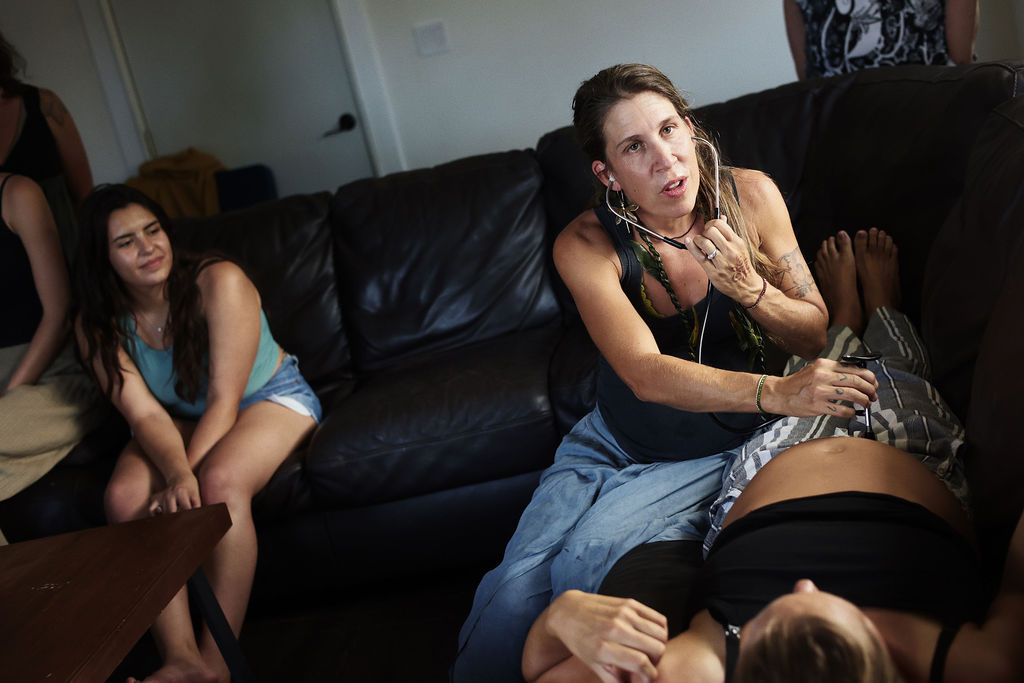
And what else is “prenatal care”? If you have a caregiver that routinely “does stuff” to you at a prenatal appointment, I urge you to re-consider how these “disturbances” may affect you and your baby. There’s something about someone telling you about you that has the potential to be disempowering. So, if you can see how you can easily be in charge of your “care”, where do you go from here? First, touch your belly. Starting at the very beginning of pregnancy, all the way to the end. You will connect with your baby in the most amazing way as you learn to feel parts, feel your baby move and can identify the limb, know where to listen for the baby’s heart rate and find it yourself. I am proposing that it is THIS type of responsibility that will start to reform the way women go about their pregnancies. And again, it’s not about doing it alone, or thinking you know everything. It’s about not giving this responsibility to anyone else; and even if you want or need help with certain aspects, that you are right there alongside the person who’s instructing you. Same goes for your own vitals; do you know your normal blood pressure and pulse? Urine strips are overrated, but if you looked at one would you find it helpful? What would it teach you about yourself at that particular moment? Is any of this necessary? Maybe, maybe not.

Beyond the physical, there is a lot of other “stuff” that goes into an undisturbed pregnancy. Connecting with your baby on a spiritual and emotional level, committing to that prenatal bonding and nurturing that will extend into birth and afterwards. Doing your own work (again, with guidance if desired) on your own birth. Births you’ve seen or heard about. Your relationship with your mother. Your relationship with your partner. All the deep dark places that may still hold fear about birth or about mothering. Acknowledging the unknown at the same time that your honor the legacy of all the women that have birthed before you. Doing your work, muddling through at times, but knowing that only you can do this work. Honoring the transformation of you and your baby on all levels.

As guides or educators or birth attendants, our ability to observe and support women in an undisturbed pregnancy comes from a unique blend of holding space and allowing space. Let me explain what I mean; holding space means that we structure the support to meet the woman’s needs. We provide her with all the information we have to make a decision, and find other less obvious ways to reflect to her her own power. We do what is asked of us and no more. Allowing space is sort of the follow through; now that she feels secure in her resources and choices, we let go, just as she also lets go. We literally allow her the space to do exactly what she needs to do, with love and without judgement. To me, this is the recipe for supporting a woman in creating an “undisturbed pregnancy.”

And in an undisturbed pregnancy, most women will naturally bring this confidence and power with them to the labor and birth. It will be inevitable, because for many months, she will have practiced and honored what is in her. Whether someone is by her side or not is irrelevant, really, because she holds this power within.

The power within.

The Freebirth of True

I love writing my birth stories. At less than 24 hours post birth I am starting this one, because I don’t want to forget one second of how it all went. I sit here with this precious angel next to me, and I can’t stop reflecting on how he chose to come into this world.

But when you’ve had a bunch of babies, birth stories can’t and don’t really stand completely alone. Writing about this birth feels like the final piece to a puzzle, the last chapter to a book about my childbearing years. What was at first glance the “hardest” birth of them all has quickly become, in many ways, the most significant, profound and life changing. Perfect for the last birth story I will tell.

My birthing history began almost 10 years ago, with a sort of naively wonderful hospital birth that taught me more than I ever thought possible. The second, my first homebirth that brought me passionately into midwifery and serving women. Third, a truly lovely homebirth that taught me different lessons. Fourth, my homebirth that challenged me as I never dreamed of having to transport my newborn son immediately after birth. Fifth, the quickest most textbook, deliciously perfect (home) birth that I had experienced myself.

Birth stories also don’t stand alone in time and space-each pregnancy and birth (I see even more clearly now) was woven from the fabric of my life at the time. The birth simply reflected who I was, where I was, and what I thought about life and birth.

So, seeing this last birth in that light makes so much perfect sense to me. I “knew” this birth wouldn’t be pure and simple, as much as I craved that as a change to my life this past year. I knew, deep down, that it would be a right of passage and that the lessons this babe was bringing were my absolute truths about life and birth. In my conversations with this spirit, I knew this. And his name was born well before he was-he’d be called “True”, for being the beacon and reminder to me of my deepest and most profound beliefs. He told me he would help show me what was “true” about myself, about birth, that which I had been struggling with for months.

And to be honest, I did struggle immensely during True’s pregnancy. Fear, doubt and losing my way in the world seemed to happen regularly, and it would collapse me into such guilt. It was often this little soul that would remind me he was strong, he was here for a reason and if nothing else, was looking out for me too. For the first time, I doubted my body. Not the entire time, but initially, because we had lost a baby to miscarriage only months before. It took me a solid while to trust that True would not and did not want to go anywhere, assuring me that he had strong intentions to incarnate in this form. On the other hand, this was probably my most physically healthy pregnancy. For this first time, it seemed like I was eating enough. I gained at least 50 lbs. (didn’t look at the scale past a certain point, so I don’t really know) and felt really good.

And now the birth story-

He was “due” only the day before, but since all the others were a bit early, it was the longest I have waited! Typical 6th baby; nights of contractions leading up, but they’d quit by morning and I’d wake up pregnant. I got the feeling time and time again that it would be a slow build up to labor, and even though I “wanted” a super, quick and easy birth, I wasn’t so sure I would get it.

Went to bed on May 18th with the typical run of contractions, although more pressure than normal. Stopped somewhere through the night, and started up again at 5:30 am on May 19th. Somewhere in me I knew this was the beginning of “it”-but I had no idea how long it would last and if this babe would come today or even tomorrow. It just had that “different” feeling, even though the contractions were totally irregular and would even stop for 15-20 minutes at a time. Kind of how my fifth labor started out, but even less predictable. Still no mucous or blood or anything to reassure me, so I just went about my day as best as I could.

At about 2 pm, I laid down in bed with Belgium to see if I could rest. It was difficult to remain still during contractions, and I thought, “Really? Already?” True always liked to hang out on my right side but at this precise moment I felt him move forcefully to my left side. Literally minutes later the contractions got more regular.

By 4 pm, I knew this was “it” but still not predictable. However, the pressure was increasing. I knew I didn’t want a midwife there, but I did want my friends in addition to my husband. I called my friend Margo to come and also my friend Jenni who is a pro photographer. I hadn’t totally decided if I was comfortable with pictures but I thought she could come for now at least…with both of them I hated having to make the “phone calls” (even though I love them both!) just from that element of feeling like people would be here “waiting” for me. (And not that they felt that way at all, that’s my own baggage!)

They arrived shortly and left me to my business of laboring. I labored outside on at least 3 of our decks, downstairs, upstairs and was very pace-y. I used the large tub in our bathroom, listened to music, listened to hypnosis. A lot like how I live, actually. Always busy, never resting, always on the move.

I wasn’t uncomfortable. In fact, several times, I thought it really wasn’t painful or awful or unbearable at all. I just kept needing to change my coping tactics, and even so, that was working fine. My midwife brain would look down on myself, as much as I was trying to stay out of that analytical brain-I couldn’t help it! The paranoid side of me felt like WHY was this taking so long (even though it really wasn’t) even though I knew deep down everything was normal and fine. There was nothing wrong at all, my baby and I both were doing perfectly. The only problem was my expectation or hope that the labor would be shorter, or needed to be for a 6th baby. My midwife brain assessed the situation as normal too; I watched myself deal with longer and stronger contractions, I never listened to baby but I felt him move and knew he was doing fine.

By 6 pm, I knew there was no going back. I labored in the bathroom (my sanctuary) quite a bit. Even brought my computer in so that I could put on music. Lit a candle and filled up the jacuzzi tub to see if that would help. It was getting a lot harder, but I remember thinking I wasn’t as physically close as I would like; mostly because I wasn’t minding hearing the music and I was still able to text on my phone! However it was getting rough and I was still wrestling with this idea that things should be moving so much more quickly than they were. My expectations were causing me undue fear. At one point, I even asked my friend Jenni (the photographer, although she has birthed 2 babes) if this would be over soon. All I wanted to do was get this baby out and hold him. It just felt like the longest time to wait and it wasn’t getting anymore comfortable.

I was starting to feel a little grunty around 7 pm…but definitely not full on pushy, in fact it came and went. My midwife brain just told me it wasn’t time yet, no worries. I got this feeling of surrender and just told the baby I was giving up all control; he could do what he needed to do with no fight from me. I was laboring in my room alone, when at 7:30pm I gave a tiny push and my water BROKE all over the wood floor. In all the births I’ve attended, I have never seen that much water. It was clear, and it gave me the courage to go on, knowing that it couldn’t be too long now. (I’ve never had a labor where my waters opened this early. With all the others it has been as I was pushing, and so this was new. I realized later that it definitely added to the physical intensity that was to come. When it happened, all I could think was, “Good! It shouldn’t be too long now!”) I was also able to see outside myself a bit and recognize what’s “normal” for me at this point- I was feeling shaky, and looking for reassurance that I could indeed do this. I’ve done this with every baby I’ve had, and I saw the humor in it this time.

About 15 later, I started to push involuntarily, but again not with every contraction. It would either feel really good or really not good. I had “planned” (along with my hope for a quiet, fast and peaceful birth!) that I would not push this time, but rather hope and pray for the fetal ejection reflex. I had experienced that with my 4th and 5th births, and although it was a scary sensation, it was so much less effort and trauma than my previous births where I really, athletically pushed. But this baby was asking me to push. I listened to this voice, and followed it. Lesson learned (again); being stuck on a vision of exactly how you think your birth should go generally isn’t helpful.

At first it felt really good to push-but after 20 minutes or so I began to feel frustrated, like nothing was happening. My brain went into fear mode again, and I panicked. I feared this baby wouldn’t come out-that everything I believed about birth maybe WASN’T true and that I would need help I couldn’t get. I was pushing and pushing, attempting to focus but feeling utterly defeated. I had never, ever, in 5 births felt this way before. Sure, pushing hadn’t always been pleasant (my second came out with his hand next to his face-that makes for some painful pushing!) but this was downright frustrating. My brain kept saying maybe this is not normal for a 6th baby- and I was caught in the crux of my own issue. Because if I HAD had a midwife there, it’s likely I would have felt from her that maybe this WASN’T normal. Then where would I be? Instead, I cried and asked my husband to encourage me. I knew at that moment that it was up to me. I wanted this baby out. But the only way was for me to get him out. I felt my fear, very real. I am sure I looked it, too, for at least a second. I took some deep breaths, some Rescue Remedy and knew I must move on. This baby was coming out hell or high water.

After pushing in the tub, I hopped out quickly and I grabbed my bed and went into a deep squat, pushing sort of wildly. Jason supported me so wonderfully, just quietly whispering that I could do it, that I was almost there. But still, no head. Not even a sliver.

The deep squat was killing my legs. I am not a squatter and so I laughed later ay my choice of position. However, I made it into the squat quite well at the moment and remembered instinctively that I must have needed whatever extra space that afforded me. It was both terrifying and relieving-my body felt out of control with these pushes, yet I was SO determined to hold him. I don’t remember in previous births caring that much about the baby at this point in labor, but in this one, it was what kept me going. With every push I visualized his head moving down and I kept seeing and feeling what it was going to feel like when he was out. It was either that intense visualization or giving into my fear that I was not going to be able to do this.

Still not feeling like I was making progress, the baby passed my rectum (we all know what THAT means!) and I took it to be a good sign. Then the slight burning up inside, good. With the next push I felt that inexplicable feeling as the head starts to fill up that space, and then grows. I felt the wrinkled part of his scalp as it rolled forward and was amazed. It was happening. I pushed with the next push for a lot more of his head, and then used all the patience I had left to just leave the rest to my body, all the while standing and supporting my body and his head with my hands. I was almost there, deep breath, I could taste it.

With the next contraction the rest of his head slipped out. I asked for a mirror to check his color but mostly I wanted to see his precious little face!! I leaned forward onto the bed, his head out, just waiting. I remember Jason telling me something-I realized later he was just encouraging me but at the time I thought he was wondering where the rest of the baby was. I muttered something about needing to rest, and I felt the baby rest too as he shifted and negotiated his next and final move out.

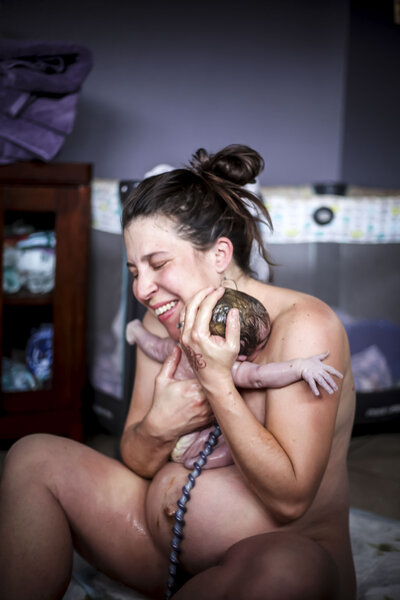
As I felt the next and last contraction surge, he rotated, some fluid spurted out and I reached down to catch him even though I couldn’t actually see what I was doing! As soon as he was out I bent with him to the floor; placed him down for just a second before I picked him back up again and smothered him with kisses. THE moment I live for and the reason I’ve birthed 5 times and love to watch other women experience the same! The smell and taste and goo of vernix and fluid were everywhere-on my lips and nose and I kissed him and talked to him. He had pooped on the way out, so I was covered with that too, but he was alert and coming around really fast. It’s amazing how the instinctual things a mother will do with her baby at birth are also exactly what the baby needs!

I was so relieved. And so proud and happy. And now so sure that following my heart was what I needed to do-even though it was a challenge. I delivered my placenta within 5 minutes or so, hardly bled at all, and was just generally in shock with the enormity of the whole experience.

I see True’s birth as perfect-not because I didn’t have anything to deal with, but because I did. Conquering my fears, my demons from the whole entire last year was the theme of my life-of this birth. There was no was of escaping it, or knowing how it would play out, exactly. But it was there, and I am that much braver and more confident and trusting on the other side. That I am truly powerful; that I can do anything. That I know what I believe about birth.

True’s birth has given me a whole new confidence; after 5 kids I didn’t think myself unconfident, but I’ve been shown how much farther there is to go. I am complete trust, in complete trust of this tiny person that has shown me. Experiencing True’s labor and birth has been a profound teaching gift for me. We needed to do it the way we did; and not a smidge different or a moment sooner or later. It was the most PERFECT birth; in so many ways, much more sophisticated with it’s teachings than anything else I have experienced. With it came peace about the rest of my life right now; that I know who I am, what I want and where I am going. I know what I believe and birth and the women I serve. I know where I belong and where I do not belong. And for this, I thank this babe.

Perhaps, needless to say, I am done with this amazing chapter of my life. I could not have asked for a more beautiful and blessed childbearing decade, and now I look forward to raising all of these spirits. I am so grateful for my babies, my births and for the profound lessons I have learned. I look forward to the next chapter; which is to be even more sincere and true in my intent to serve women in the glorious world of birth.

Web Analytics